
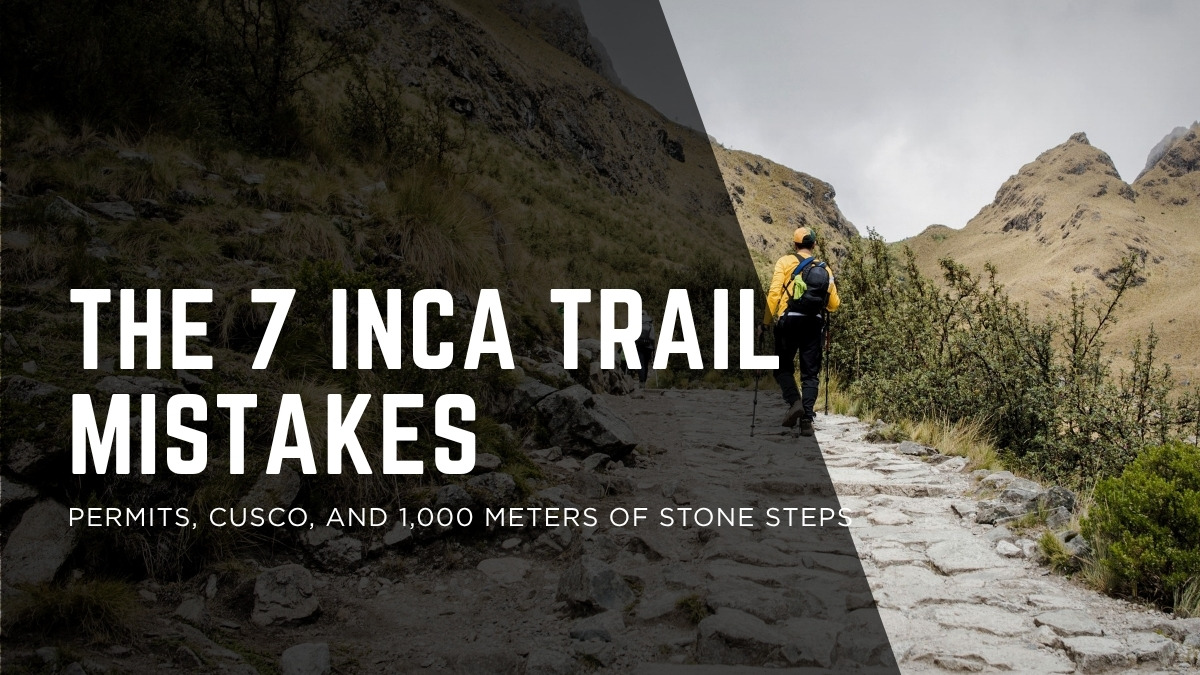
Operators rate the Inca Trail “easy to moderate.” It’s 42 km, crosses a 4,215 m (13,829 ft) pass, and sends you down about 1,000 m of stone steps on day three. The Inca Trail mistakes that end treks early mostly come from believing the rating, and the rest come from the permit system, which is unlike any other famous trek.
We walked it in late September. These are the seven mistakes we see, roughly in the order people make them, and most are made before anyone lands in Cusco.
Mistake 1: Planning around the trip date instead of the permit date
The Classic Inca Trail is capped at 500 people a day, and that number includes guides, porters and cooks. Roughly 200 of the spots go to trekkers. Permits are issued by Peru’s Ministry of Culture, tied to a named person, a date and a licensed operator, and they can’t be transferred or bought independently.
Sales for the following year usually open in October or November. June, July and August fill first, often within days of opening, and May and September follow within weeks. If your dates are in the dry season, you book within the first two weeks of the window or you don’t walk the Classic trail that year.
We booked in mid June for a late September trek and found a window of a few months worked. For July, that window doesn’t exist. And the trail closes every February for maintenance, so there is no February plan.
If the dates are gone, the Salkantay and Lares routes don’t run on permits. Both cross passes higher than Dead Woman’s Pass and still end at Machu Picchu, though you reach the site by train or bus, not on foot through the Sun Gate.
Mistake 2: Believing “easy to moderate”
The rating comes from operators selling four day trips to a broad market. It ignores the three things that make the trail what it is: altitude, stone, and no flat ground.
Day two climbs about 1,200 m from Wayllabamba to Dead Woman’s Pass at 4,215 m, where each breath delivers roughly 40% less oxygen than at sea level, and then drops about 600 m to camp. Day three crosses two more passes above 3,600 m and descends about 1,000 m of Inca stone steps. Day four starts at 3 a.m.
None of that is technical. All of it is hard, and the rating sets people up to under-train. One of us found day one, the “easy” day, more draining than expected, and that was with a year of training in the legs.
Compared with Everest Base Camp and Kilimanjaro, the Inca Trail is the shortest and the lowest. It is also the only one of the three where most of the climbing and descending happens on steps.
Mistake 3: Landing in Cusco and starting the next morning
Cusco sits at about 3,400 m. The trail starts at Km 82 near 2,700 m and stays at or above 3,000 m from the first camp until the descent on day three. There is no gradual approach. You fly from sea level, step off the plane at 3,400 m, and the clock starts.
Fitness doesn’t change your risk of altitude illness. The CDC’s guidance is that time does. We spent three days in Cusco before the trek, and one flight of stairs on the first afternoon left us breathless. By day three in town it had settled. People who land Tuesday and start Wednesday are carrying that first-afternoon body up to 4,215 m.
Three nights in Cusco or the Sacred Valley before Km 82. Walk slowly in town, skip alcohol, and treat the Sacred Valley’s lower altitude as an option for the first night if you arrive feeling rough. You can’t acclimatize before you fly, so the three days are the only place to buy it.
Mistake 4: Training for the pass and not the steps
Everyone trains for Dead Woman’s Pass. It’s the famous number on the profile. What took us by surprise was the far side: the descent from the pass tested our knees more than the climb did, and day three’s 1,000 m of stone steps was worse.
Each downhill step is a braking contraction. The quads lengthen under load, and that eccentric work damages muscle more than climbing does. Stone steps make it worse than a trail descent, because every step is a full-height drop with no gradient to share the load.
Train the way down for the final two months: slow step-downs off a box, split squats with a slow lowering phase, and long stair descents with a light pack. Take poles, with rubber tips, which the sanctuary asks for to protect the stone. Day three is where you find out whether you did this.
Mistake 5: Choosing the operator by price alone
Peruvian law caps porter loads at 44 lb (20 kg) for men and 33 lb (15 kg) for women, and loads are weighed at checkpoints. Operators that undercut the market find the margin somewhere, and it is usually the porters: pay, food, sleeping equipment, or a duffel allowance that quietly expects them to carry more.
Ask three questions before you book. What do porters get paid? What do they eat and where do they sleep? What’s the client duffel allowance, including the sleeping bag? A company that answers clearly is a company that has thought about it. One that changes the subject has answered too.
Your duffel allowance will usually be around 15 lb (7 kg) including your sleeping bag, which varies by operator. Pack to it. Overfilling the duffel is a weight problem for someone else.
Mistake 6: Treating day four as the victory lap
Day four is 5 km. It’s also the day with the 3 a.m. alarm, a queue in the dark at the checkpoint below Wiñay Wayna, which opens at 5:30 a.m., a push along the final section with every other group, a crowded Sun Gate, and then Machu Picchu itself, on foot, on legs with three days and 1,000 m of steps in them.
People arrive at the ruins wrecked, having saved nothing for the part they came for. Eat before the queue. Keep the poles. Walk the site at the pace of someone who has already finished the hard part, because you have.
Mistake 7: Renewing your passport after you book
The permit is tied to the passport number you booked with. Renew your passport between booking and departure, and the number changes, and the name at the checkpoint doesn’t match the document in your hand. Operators can usually update the permit if they’re told in time, and many advise carrying the old passport as well, but the trekker who finds this out at the Km 82 checkpoint has no options left.
Tell your operator the moment a new passport is issued. Carry both. And check the name on the permit against the passport before you leave Cusco, because the one thing the 500-a-day system doesn’t forgive is a mismatch at the gate.
The Inca Trail mistakes that are made before Cusco
Four of the seven happen at home: the permit timing, the training, the operator choice and the passport. One happens in Cusco, the three days most people skip. Only two happen on the trail, and both are easier with trained legs and three nights of altitude behind you.
It’s the same lesson as Kilimanjaro: a trail with a reassuring rating ends plenty of trips early, and almost never because the trail was beyond the person walking it.
The descents, the stairs and the back to back days are what our 8-Week Trekking Fitness Plan builds: strength and aerobic conditioning, stair climber sessions, a ruck progression from 45 to 75 minutes building to 3 to 4 hours by week 8, bodyweight alternatives, and a video demo for every exercise.
