
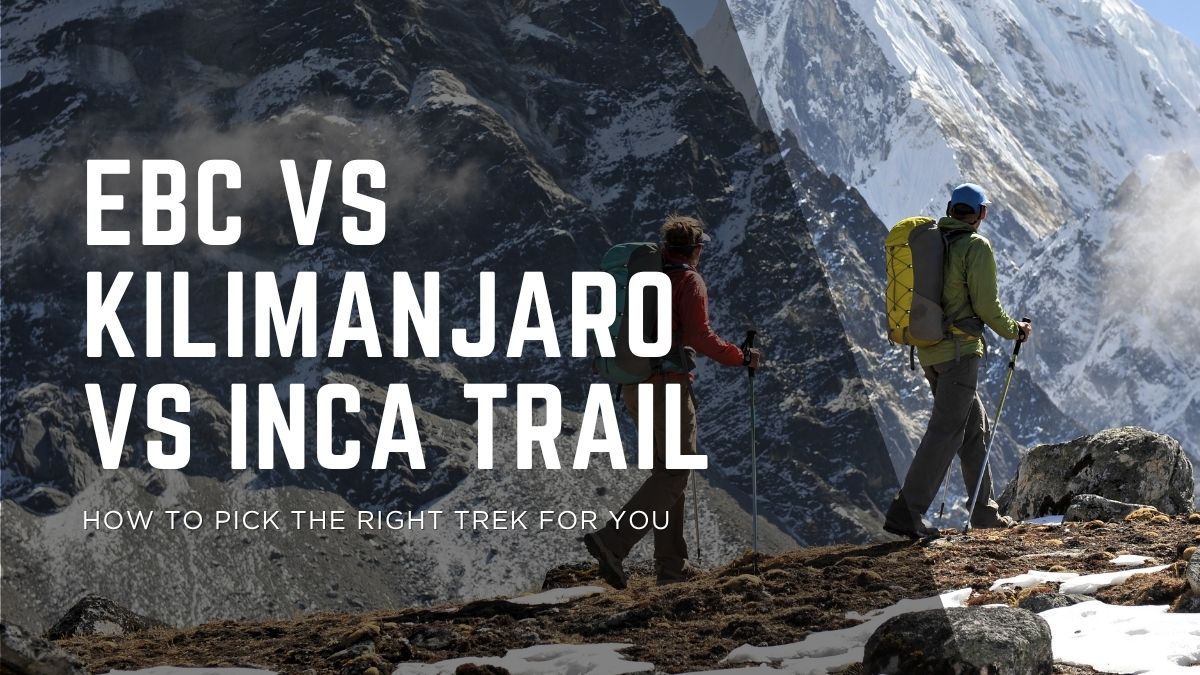
Standing at a crossroads between the world’s three most famous treks? You’re not alone. Everest Base Camp, Kilimanjaro, and the Inca Trail are the “Big Three” of adventure trekking, and every year they draw tens of thousands of people chasing a life changing trip.
Here’s what the glossy brochures won’t tell you: these are not three versions of the same experience with different scenery. They are fundamentally different challenges. One is a two week endurance test. One is a rapid altitude gamble with a brutal summit night. One is a four day sprint up and down ancient staircases that’s harder to book than it is to hike, and still harder to hike than people expect.
We’ve walked all three, and we’ve trained plenty of people heading to each. Choose the one that matches your time, your body, and what you actually want from the trip, and you get the adventure of a lifetime. Choose on scenery alone and you can turn a dream into a very expensive bad time.
Here’s how to choose well.
A note on numbers: prices, permits, and rules for all three treks change regularly. Success rates are estimates commonly used in the industry, not official statistics. Treat the figures here as a guide and confirm current details when you book.
The Big Three at a glance
| Everest Base Camp | Kilimanjaro | Inca Trail | |
|---|---|---|---|
| Trekking days | 12 to 16 | 5 to 9 | 4 |
| Distance | ~130 km / 80 mi round trip | about 50 to 95 km / 30 to 60 mi, by route | 42 km / 26 mi |
| High point | 5,364 m / 17,598 ft | 5,895 m / 19,341 ft | 4,215 m / 13,829 ft |
| The core challenge | Sustained endurance at altitude, day after day | Rapid ascent and a huge summit day | Relentless stone staircases at altitude |
| Guide required | No (the Khumbu opted out of Nepal’s 2023 guide rule) | Yes | Yes, permit sells out |
| Typical trek cost | roughly $1,500 to $3,500 | roughly $2,000 to $4,500 | roughly $700 to $1,200 |
| Best seasons | Mar to May, Sep to Nov | Jan to Mar, Jun to Oct | May to Sep (closed Feb) |
| Booking lead time | Weeks to months | Months | 6 to 12 months, permits vanish fast |
Three very different animals. Let’s take them one at a time.
Everest Base Camp: the endurance test
EBC is the longest of the three in every sense. Twelve to sixteen days of hiking, six to eight hours most days, sleeping higher and higher in the Himalayas until you stand at the foot of the world’s highest mountain. You’re not climbing Everest, but you’re walking the approach that has captivated mountaineers for a century, through Sherpa villages, past monasteries, under peaks like Ama Dablam that will fill your camera roll.
The defining feature is accumulation. No single day on the EBC trail is extreme. What gets people is day after day of effort while sleeping at altitude, where recovery slows right down. Each morning starts with slightly less in the tank than the last. Fitness that survives one big day isn’t the same as fitness that survives fourteen in a row, and that’s the specific thing EBC tests.
The trade off for the long itinerary is a genuine advantage: gradual acclimatization. EBC gives your body more time to adapt than Kilimanjaro does, with built in acclimatization days along the way. Respect the schedule and drink your tea slowly, and most prepared trekkers adapt well.
EBC is your trek if you have three weeks or more for the full trip, you love the idea of living in the mountains rather than visiting them, and sustained effort appeals to you more than a single dramatic summit. It’s also the pick if the Himalayas themselves are the dream, because nothing else on this list looks like Khumbu.
Think twice if your vacation time is tight, if you’ve never done consecutive hiking days and can’t train for them, or if the idea of two weeks of teahouses, cold nights, and basic comforts sounds more like a sentence than an adventure.
Prepare by building an aerobic base that can handle back to back days. Long weekend hikes on consecutive days are worth more to you than any single heroic workout. Our full Everest Base Camp preparation guide covers the details, and our high altitude training guide explains what the thin air actually does to you and how to get ahead of it.
Kilimanjaro: the deceptive giant
Kilimanjaro is the highest point on this list, the highest peak in Africa, and the only one where “summit” is the right word. It’s also the one people underestimate most, because “you just walk up it” is technically true and practically misleading.
Two things make Kili what it is. First, the speed: most routes take you from around 1,800 meters to 5,895 meters in five to nine days, far faster than your body would like. That makes Kilimanjaro the most altitude sickness prone of the three treks, and it’s why route choice matters more here than anywhere else. Longer routes give your body more time, and the commonly cited success rates tell the story bluntly: eight and nine day routes see the strong majority of trekkers summit, while the short five day itineraries see fewer than half make it. Saving two days is the most expensive discount in trekking.
Second, summit night. You start around midnight, in the cold and dark, and climb for six to eight hours to reach the crater rim near sunrise. Then comes the part nobody talks about: you turn around and descend roughly 2,800 vertical meters that same day. It’s a 12 to 16 hour effort, and the descent lands on legs that just gave everything to the climb. It’s exactly why we push training for the descent so hard, because on Kilimanjaro the way down is not the easy part, it’s the second half of the hardest day of your life.
Kilimanjaro is your trek if standing on a true summit matters to you, your schedule only allows a week or so of trekking, and you’re willing to pay for a longer route to protect your chances. It’s a guided experience by law, camps are full service, and highly motivated first timers do succeed here, provided they train seriously and choose their route wisely.
Think twice if you’ve reacted badly to altitude before, if budget pressure is pushing you toward a five or six day route, or if you’re expecting the “easy walkable mountain” of internet legend.
Prepare by building the engine for one enormous day: long sustained efforts, plenty of climbing, and legs that can handle a massive descent when they’re already tired. Our Kilimanjaro summit guide breaks down every route and its success rates, and our Kilimanjaro packing checklist covers the five climate zones you’ll walk through to get there.
The Inca Trail: the booking war and the staircases
The Inca Trail is the shortest trek here, and the only one where the hardest part happens before you leave home. Permits are strictly capped, staff included, and the slots left for trekkers disappear months in advance for peak season dates. If this one’s calling you, the planning clock starts six to twelve months out. (We’ve written about the permit game in detail, including why “sold out” doesn’t mean what people think.)
Once you’re on it, the trail has a personality unlike anything else on this list. This is not a mountain path. It’s thousands upon thousands of ancient stone steps, uneven and irregular, climbing to Dead Woman’s Pass at 4,215 meters and then dropping down the other side, linking ruins through cloud forest until the Sun Gate finally hands you that first view of Machu Picchu. Four days, no rest days, and very little flat ground anywhere.
The trail’s dirty secret is the descents. Everyone fears the climb to the pass. It’s the endless downhill staircases afterward that wreck unprepared legs, because irregular stone steps are the most punishing descent surface there is. Strong knees and stable ankles matter more here per kilometer than on either of the other two treks. And while the altitude is the lowest of the three, don’t shrug at it: you’ll spend days above 3,300 meters, and a couple of acclimatization days in Cusco beforehand are non negotiable.
The Inca Trail is your trek if the history is the draw, you can only carve out a week or so including Cusco, and you’re organized enough to book far ahead. Walking into Machu Picchu on the original pilgrim route, past ruins day hikers never see, is an experience no other trek can copy.
Think twice if you can’t book early (look at the Salkantay or Lares treks instead, both genuinely great), if crowds bother you, or if your knees already complain on regular stairs and you’re not willing to train them.
Prepare by making stairs your best friend, up and down, ideally with a loaded daypack. Our complete Inca Trail success guide and packing list cover the rest.
The quick decision guide
If this is your first big trek: Kilimanjaro on a longer route, or the Inca Trail if you’ll commit to stair training. Both are guided, structured, and achievable for a well prepared first timer. EBC rewards some multi day hiking experience first.
If you’re an experienced hiker chasing the biggest challenge: EBC. It’s the most complete test of the three and the deepest immersion in big mountains.
If time is tight: Inca Trail (about a week door to door including Cusco) or a seven day Kilimanjaro route. EBC needs three weeks and doesn’t compress; the “shortcut” itineraries just remove the acclimatization you need.
If altitude worries you: Inca Trail has the lowest high point and sleeping elevations, EBC gives the most gradual exposure, and Kilimanjaro is the riskiest profile of the three. Whatever you choose, no one is exempt from altitude, and fitness is not immunity.
If the budget is leading the decision: the Inca Trail is the cheapest trek to run, though flights and Cusco time close the gap. Just don’t let budget push you onto a short Kilimanjaro route. That’s not saving money, it’s buying a coin flip.
If you’re chasing a feeling: EBC is about being among giants. Kilimanjaro is about standing on top of something enormous. The Inca Trail is about walking through a civilization. All three are extraordinary. They’re just extraordinary in completely different ways.
What all three have in common
Different as they are, the Big Three agree on one thing: they reward the people who show up prepared and quietly punish the ones who don’t. Every one of them demands a real aerobic base, legs built for climbing and, just as much, for descending, and a body that’s spent time under a loaded pack before the trip rather than discovering it on day one.
That preparation doesn’t require anything exotic. It requires eight to sixteen weeks of consistent, trek specific training, which is exactly what our Complete Trek Preparation Guide walks through step by step, and what our Trekking Fitness Plan turns into a week by week program if you’d rather have it all laid out.
Whichever trail you choose, choose it with open eyes, give your body the time it needs, and one of the world’s great experiences is waiting at the end of it. See you out there.
