
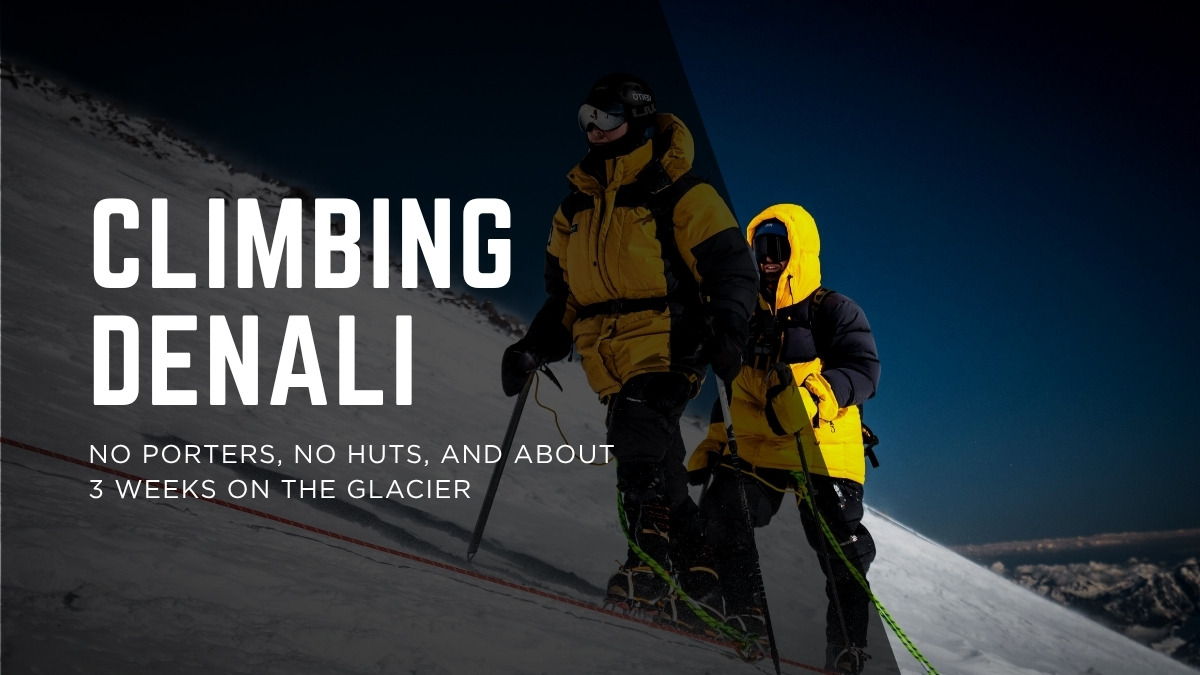
On Kilimanjaro, porters carry the camp. On Everest’s south side, Sherpa teams fix the ropes and stock the high camps. On Denali, the climber pulls a sled. Climbing Denali by the standard West Buttress route means roughly three weeks on the Kahiltna Glacier with everything you need for those three weeks split between your pack and a sled clipped to your harness.
At 6,190 m (20,310 ft), Denali is the highest summit in North America and one of the Seven Summits. The altitude is the easy part to explain. What makes the mountain hard is the combination of load, cold and weather, and understanding that combination is useful even if you never go, because it changes what “hard” means on every other mountain.
A note on the name. Since 2025 the federal government’s official name for the peak is Mount McKinley again, and NPS permits are issued under that name. The park is still Denali National Park and Preserve, the State of Alaska still uses Denali, and so does this article.
Denali at a glance
- Summit: 6,190 m (20,310 ft), the highest point in North America
- Standard route: West Buttress, from Kahiltna base camp at 2,200 m
- Trip length: plan on about 3 weeks, including weather days
- Loads: commonly 100 pounds or more per climber early on, split between pack and sled
- Registration: register and pay the NPS mountaineering fee 60 days before your climb, then an in person orientation in Talkeetna
- Summit rate: in 2026, 582 of 976 registered climbers summited, about 60% (NPS)
No porters, no huts
In the Himalaya, porters and yaks move expedition loads. On Kilimanjaro, support crews carry and cook, and on Aconcagua you can hire porters above base camp. Denali has no local porter industry. Tents, fuel, food, ropes and arctic clothing for about three weeks go up the mountain on the backs and sleds of the climbers themselves, guided or not.
The paperwork starts early. The NPS mountaineering program requires every climber to register and pay 60 days before the climb. The trip itself starts in Talkeetna, a small town north of Anchorage, with a ranger orientation at the Walter Harper Talkeetna Ranger Station. Then a ski plane lands you on the Southeast Fork of the Kahiltna Glacier, the longest glacier in the Alaska Range at about 71 km. From base camp the West Buttress climbs about 4,000 vertical meters to the summit through a string of camps:
| Camp | Elevation |
|---|---|
| Kahiltna base camp | 2,200 m |
| Camp 1 | 2,380 m |
| Camp 2 | 3,410 m |
| 14 Camp | 4,330 m |
| High camp | 5,240 m |
| Summit | 6,190 m (20,310 ft) |
Progress is slow on purpose. Carry a load high, bury it in a cache, drop back to sleep, move camp up the next day, go back down for the cache. That double carry builds acclimatization and splits a load too heavy to move in one trip. Motorcycle Hill above 3,410 m, Windy Corner, and the fixed lines on the headwall above 14 Camp mark weeks of heavy, repetitive work.
“Non technical” gets attached to the West Buttress because the terrain rarely needs hard climbing. It’s glacier travel, cramponed snow slopes, fixed line ascents and an exposed summit ridge. The label describes the climbing moves. It says nothing about the risk. The lower Kahiltna is crevassed under snow bridges that soften as the season warms, and the skills that keep a rope team alive there, crevasse rescue, sled rigging, navigating in whiteout, are real mountaineering craft that you practice under a load you would never carry on a backpacking trip.
Climbing Denali in the cold
The second problem is latitude. Denali sits at 63 degrees north, about 3.5 degrees south of the Arctic Circle. At high latitude, air pressure at a given elevation runs lower than it would near the equator, and the gap widens in cold weather, so the summit can feel higher than its 6,190 meters. Storms roll in off the Gulf of Alaska and the Bering Sea and can hold teams in their tents for days at 14 Camp or high camp, behind snow walls they built themselves.
That’s why the season is compressed. Guided teams and the NPS ranger patrols work from late April or May into July, and 2026 showed how much weather controls the calendar. NPS reported an unusually poor May that delayed the ranger camp setup on the West Buttress until late May, then an 83 person summit day on June 3 when the weather finally cleared.
Weather days aren’t a risk on Denali. They’re a line item. Teams budget several spare days at 14 Camp and again at high camp, and the ability to sit in a tent, eating and drinking on schedule until the weather clears, decides as many summits here as fitness does. Turning back, and waiting, are both part of climbing it.
The cost of getting it wrong is not abstract. In 2026, NPS recorded five climbers killed on the West Buttress, including one of the park’s own climbing rangers, and 28 search and rescue helicopter operations.
Where Denali fits on a climbing resume
Near the top. Guided operators screen for winter camping experience, previous cold high altitude expeditions, and the fitness to move uphill for hours under the heaviest pack of your life, day after day, for weeks.
The climbers who do well on Denali usually get there by a ladder: a first glaciated peak, then bigger cold summits, then a long altitude expedition like Aconcagua, which shares Denali’s duration and load carrying and adds the altitude patience. Our Seven Summits explainer puts Denali next to the other six, from the Kosciuszko day hike to Everest.
How you train for it
Denali is won with load carrying conditioning, built over months, because hauling is the job description. A sled adds a pull through the hips that a pack alone doesn’t, and dragging a tire on local trails is a common Denali training drill for exactly that reason.
Around that sit an aerobic base big enough for three weeks of work, legs that can descend thousands of meters under load at the end of the trip, and a body that keeps eating in the cold when appetite disappears. Summit day from high camp is commonly 9 to 12 hours round trip, and it comes near the end of the expedition, on whatever fitness you have left.
Our 10 Week Mountaineering Fitness Plan is honest about its ceiling. It names Aconcagua as the top of what it prepares you for, which makes it a rung on the way to Denali, not a Denali program. The rungs it does cover are the ones that get you here: loaded rucks that build to 3 to 4 hours, full carry options up to 20 to 25% of bodyweight, and descent work in every week.
