
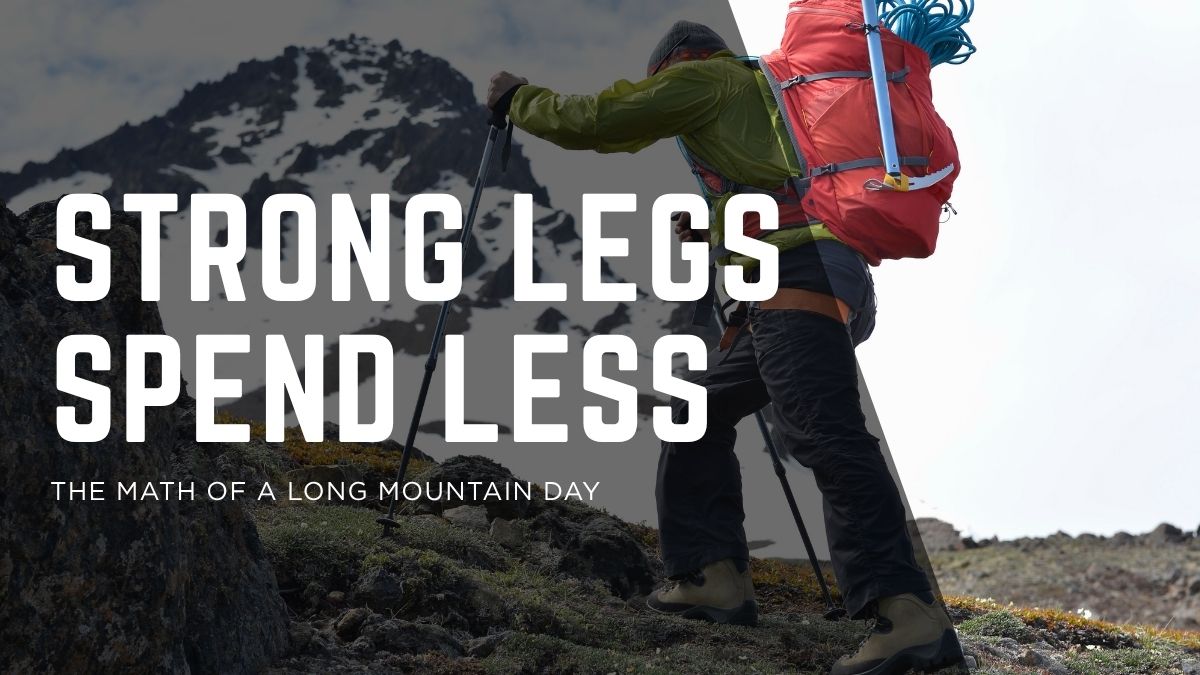
Most people file strength under lifting and file mountains under cardio. We think that misses the most useful thing strength does for a hiker, trekker, or climber.
Every step you take costs a percentage of your maximum. If your legs are twice as strong, the same step costs half the fraction of what you have. Multiply that by the tens of thousands of steps in a long mountain day and the math becomes the whole story. Strong legs spend less energy per step, hour after hour, all day.
That is the argument in one paragraph. Here is why it holds up, and what it changes about how you should train.
Where the price actually shows up. Not in the first hour. The first hour feels fine on almost any legs, which is exactly why day hikes fool people about their readiness for bigger things. The bill arrives in the afternoon. Steps get shorter and sloppier. Feet start landing flat instead of being placed. The little stumbles begin, the toe catches, the ankle wobbles on a rock that would have been nothing at 9 am. Fatigue does not just slow you down, it degrades your movement, and degraded movement on uneven ground is where trips go wrong. Strength is what holds your technique together after fresh is gone.
The descent sends its own invoice. Going down, your legs work as brakes. Every step absorbs your bodyweight plus your pack, thousands of times, usually after the climb has already taken its share. This braking style of muscle work is more damaging to unprepared legs than climbing is, which is why the soreness that follows a big mountain day comes mostly from the way down, and why the descent deserves its own training attention. For now, one sentence carries the point: the stronger the leg, the smaller the share of its capacity each braking step burns, and the longer it lasts before it starts to buckle.
Strength keeps you aerobic longer. When a step costs a small fraction of your strength, the muscles doing it stay comfortable and the effort stays in your easy, sustainable zone. When each step costs a big fraction, the same pace quietly becomes a grind, breathing climbs, and you drift into the effort level that burns you down. Same trail, same speed, different bodies, completely different day. The engine sets how long you can go. Strength sets how much every minute of it costs. They are one system, and training only one of them is paying for half a mountain.
There is also free energy in a strong leg. Better conditioned legs let the springy tissue do more of the work, storing and returning energy with each stride instead of paying full price every time. Cheap, elastic steps early in training become the steps you still have late in the day.
“Just hike more” is half right. Hiking absolutely builds leg strength, right up to the point where your bodyweight stops being a challenging load. After that, more hiking mostly builds more endurance at the strength level you already have. The ceiling stops rising. Progressive strength work keeps raising it, because the load keeps growing in a way a trail cannot safely provide, especially for the braking work your descents depend on. Hike for the engine and the skill. Lift for the ceiling.
And it matters more every decade. Strength fades faster with age than endurance does when neither is trained, which is why the fifty-something trekker who lifts routinely outlasts thirty-somethings on the descent. If your trips are getting bigger while your birthdays keep arriving, strength work is not optional seasoning. It is the part of training that pays compounding interest.
We felt all of this in July, on Baker and Rainier. Months of structured aerobic work before the trip, including a block built around a half marathon, meant heart rate stayed low on climbs that had other lungs working hard. Different training implement, same engine. And the strength side did the quiet part: every loaded step, every rock hop, every braking stride on the descent cost a smaller slice of the day. We finished days with something left, which on a mountain is not a luxury. It is the margin that keeps you safe.
This is why our plans put serious strength work right alongside the long aerobic days, and treat the two as one system rather than a choice. A couple of focused strength sessions a week, built around the patterns the mountain actually uses, squatting, hinging, stepping, and carrying, is enough to move the math for most objectives.
Cheap steps stack up. Over a ten hour day, they might be the difference between arriving at the top with something left, or arriving at your limit with the entire descent still to pay for.
