
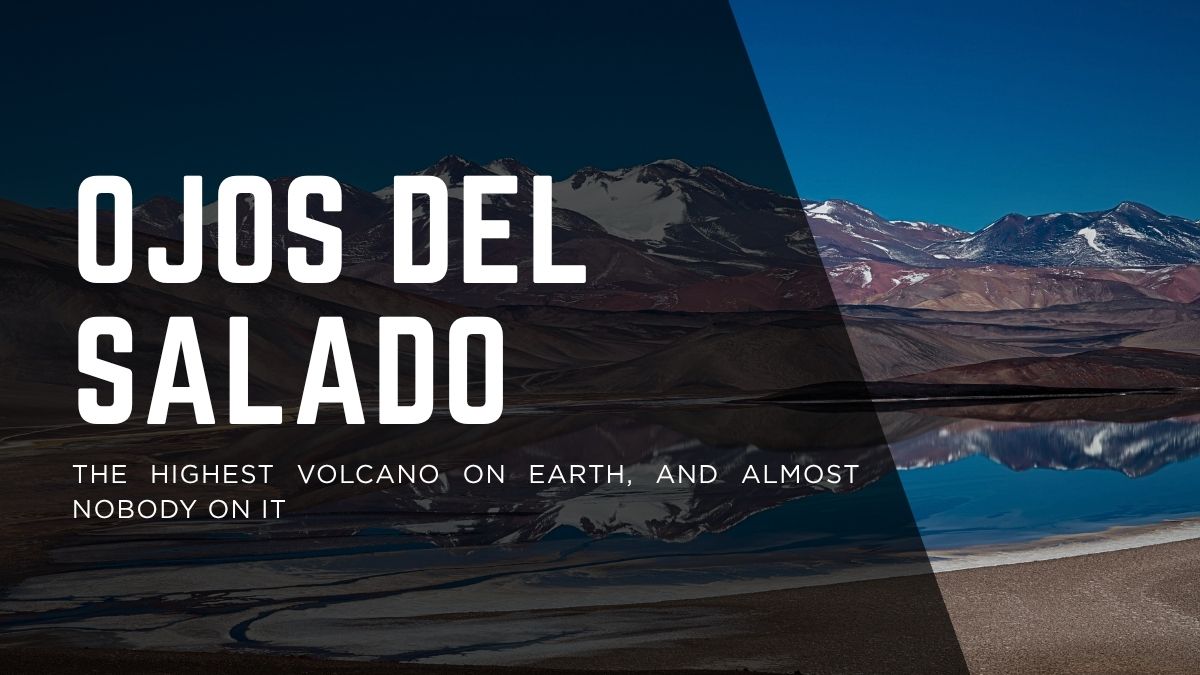
Ask a room of trekkers to name the highest mountain in the Americas and most will get it: Aconcagua. Ask for the second highest and the room goes quiet. The answer is a mountain many of them have never heard of, with a road running absurdly high up its side.
Ojos del Salado rises to 6,893 meters on the border of Chile and Argentina, in the Puna de Atacama, the high desert shoulder of the driest place on Earth. It’s the highest volcano in the world, the highest point in Chile, and it stands taller than anything in North America, Europe, Africa, or Antarctica. We’ve stood on its summit, and here’s the strange part: on a good season day you might share the entire upper mountain with a handful of other people.
The “highest active volcano” argument, settled honestly
You’ll see Ojos del Salado billed everywhere as the world’s highest active volcano, and you’ll also find volcanologists who push back, since its last confirmed eruption was somewhere around 1,300 years ago. Whether a mountain that’s been quiet that long counts as “active” or “dormant” is a definitional fight we’ll leave to the scientists.
What isn’t in dispute: it’s the highest volcano on Earth by every measurement, it still vents fumaroles near the summit, and it tops the Volcanic Seven Summits, the list of the highest volcano on each continent. The title that matters holds up either way.
What kind of climb this is
Technically, almost none. The normal route from the Chilean side is a long, high walk on volcanic scree and, depending on the year, patches of snow and penitentes, until the very end. The final stretch to the crater rim steepens, and the last few meters to the true summit involve a short section of easy roped scrambling. Many parties fix a rope there; guided groups handle it as a matter of routine. That’s the entire technical content of the mountain.
Which is exactly why nobody should confuse it with easy. The route itself is mostly a walk. Altitude, cold, and wind are what make it hard. Summit day temperatures commonly sit between minus 25 and minus 30 with wind on top, and the Puna’s wind is famous for ending summit bids that fitness alone would have finished. At nearly 6,900 meters you’re operating with roughly 40 percent of the oxygen you’d have at sea level, on a mountain where the dryness dehydrates you faster than almost anywhere you’ve climbed. A large share of attempts turn around. The mountain is a walk, and the walk is savage.
The infrastructure is the surprise
Here’s what separates Ojos from nearly every other 6,000er: you can drive most of the way up it.
The Chilean approach runs from the city of Copiapó, five to six hours on decent roads to Laguna Verde, a startling green lake at 4,400 meters that serves as the acclimatization base, complete with rustic hot springs. From there, 4×4 vehicles can reach Refugio Atacama at roughly 5,100 to 5,260 meters, and in dry conditions even Refugio Tejos at about 5,830 meters, a metal hut with bunks that has a real claim to being the highest shelter of its kind in the world. This is the terrain where high altitude vehicle records get set, and expedition trucks have driven higher on this volcano than anywhere else on the planet.
Don’t misread the road as a shortcut. Driving to 5,800 meters without acclimatizing is a fast route to a medical emergency, and every sane itinerary climbs the surrounding smaller volcanoes first and sleeps progressively higher over one to two weeks. What the road actually buys you is logistics: no porters, no mule trains, no multi day approach marches. Your acclimatization ladder, your gear shuttles, and your bailout options all sit within a drive.
One line for clarity, as always: altitude illness is a serious subject, learn the signs from a proper medical source before any trip like this. Awareness only, not medical advice.
Season, permits, and cost
The climbing season runs November through March, the southern summer, with December to February the sweet spot. Even in season, expect wind, and build spare days into the plan for it.
The paperwork is light. On the Chilean side you need a climbing permit from DIFROL, the foreign ministry office that administers border zone peaks, and as of recent seasons it’s free. Compare that with the permit fees on the famous giants and the value math starts to look absurd: a mountain 68 meters shy of Aconcagua’s league, with hut infrastructure, for a fraction of the total cost. Guided expeditions typically run about half the price of an equivalent Aconcagua trip, and the trip is shorter too, commonly around two weeks.
The Argentine side also has routes, for the record, but it’s a far more serious undertaking: no huts, no road support high on the mountain, and long approaches through genuinely empty country. First timers on the mountain climb from Chile.
Where it fits on your ladder
Be honest with yourself here, because the easy logistics tempt people into skipping steps. Ojos del Salado is a high 6,000er and it examines you like one. The right resume before it looks like the one we’ve described for Aconcagua: real multi day trekking at altitude, at least one 5,000 meter summit like Cotopaxi or Orizaba so you know your body’s altitude response, and a genuinely deep aerobic base, because fitness is not altitude immunity but it’s the thing that keeps you moving when the air runs out.
For climbers who’ve done that homework, the numbers are hard to beat: the second highest summit in the Americas, at half the cost of the first, with almost nobody else up there. It pairs naturally with Aconcagua in a single southern season for the two highest summits in the hemisphere, and the Atacama itself sweetens the trip: some of the clearest night skies on Earth, salt flats, flamingos on high lagoons, and a landscape closer to Mars than to any mountain range you’ve visited.
The famous mountains have queues. The second highest peak in the Americas has a visitor book. That gap won’t last forever.
