
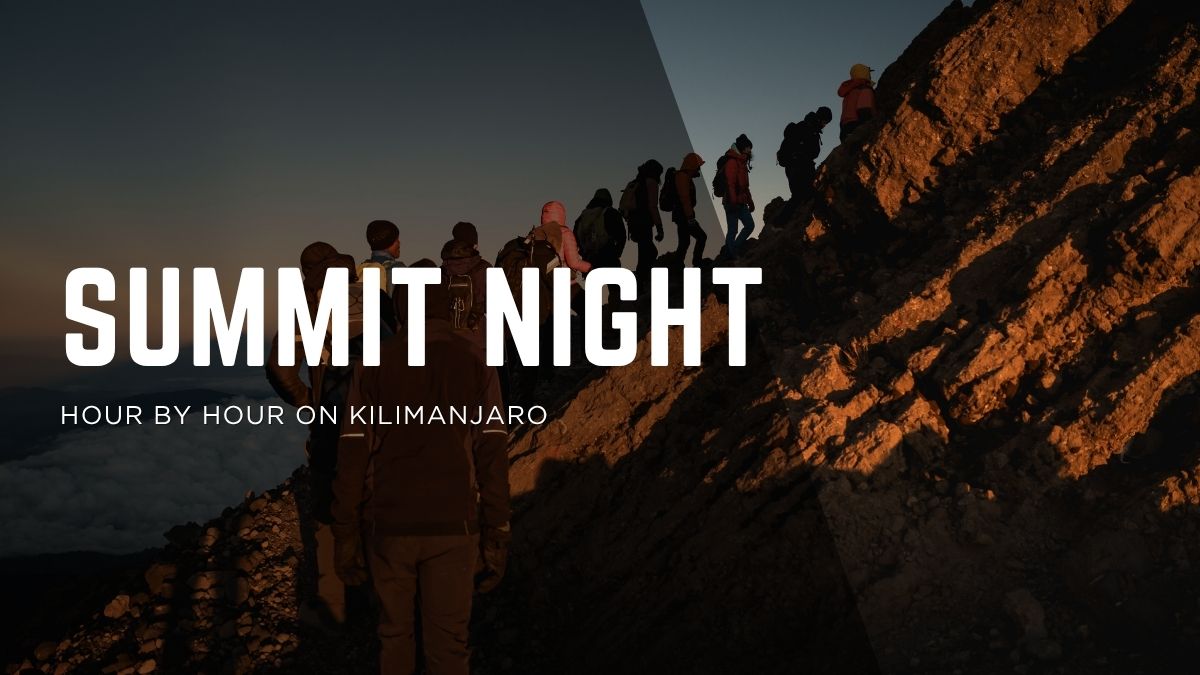
Every Kilimanjaro itinerary has one line that does nothing to prepare you for what it contains: “Day X: summit day. Begin climb around midnight.”
Kilimanjaro summit night is a 12 to 15 hour day. It starts in the dark, reaches the highest point in Africa around sunrise, then drops about 2,800 meters to a lower camp. That descent gets far less attention than the summit photo, and it’s the part that hurts most. We’ve done it, and this is the hour by hour: what happens, how it feels, and where preparation changes the experience.
This walkthrough follows the most common pattern, summiting from Barafu Camp at 4,673 m on the Machame or Lemosho side. Other routes change the camp names and the timings, and the shape of the night stays close to this.
Summit night at a glance
- Start: Barafu Camp, 4,673 m, wake-up around 11 pm
- Crater rim: Stella Point, 5,756 m, around sunrise
- Summit: Uhuru Peak, 5,895 m
- Finish: Mweka Camp, about 3,100 m, mid-afternoon
- Total: about 1,200 m up and 2,800 m down in 12 to 15 hours
- Temperature on the climb: commonly minus 10 to minus 20 C with wind chill
11:00 pm: the wake-up
You went to bed around 7 pm and barely slept. Some of that is nerves after months of thinking about this night, and some is the altitude itself, which wrecks sleep for reasons you can’t fully train away. Now there’s a voice outside the tent and tea on the way.
You dress in nearly everything you brought: base layers, insulation, shell, the big jacket within reach. Our Kilimanjaro packing checklist covers the layers that matter for this night. You force down food you don’t want, because appetite fades above about 4,000 meters and eating has become a job. Water goes in insulated bottles, or upside down in the pack so the lid freezes last.
Outside the tent, the sky is packed with stars, and above camp a zigzag line of headlamps is already climbing. That line is where you’ll spend the night.
Midnight to 3:00 am: the rhythm
The climb starts as switchbacks up scree and rock, at a pace slower than any walking you’ve done. Pole pole, the guides say, slowly slowly, and they mean it literally. One small step, a breath, another step. At this altitude that pace isn’t caution. It’s the pace your lungs can sustain, and trekkers who push past it early tend to pay for it before dawn, which is why it made our list of the biggest Kilimanjaro mistakes.
Your world shrinks to the two meters of ground in your headlamp beam and the boots of the person ahead. The cold sharpens. Guides check on everyone, and sometimes they sing. The hours settle into step, breathe, step.
3:00 am: the low point
Three hours in, sunrise still three hours off. The cold has found every gap in your layers, the altitude sits on your chest, and your brain, short on oxygen and sleep, starts negotiating. Maybe this is far enough. Maybe Stella Point counts.
Know this before you go: that hour is normal. It doesn’t mean you’re failing. It’s a stage of the night, and it passes. It’s also where months of training pay off. A trained body has spare capacity to lend a struggling mind. An untrained one has nothing to lend, and this hour is where a lot of summit attempts end.
What helps is small and specific. Eat something even though you don’t want to. Sip water before it freezes. Count a hundred steps, then count another hundred.
5:30 to 6:30 am: Stella Point and the sunrise
The horizon behind you goes deep red, then orange, and seeing the horizon at all means the crater rim is close. The final push to Stella Point (5,756 m) is steep scree where each step costs two breaths, and for many people it’s the hardest stretch of the climb. Then the ground levels and you’re on the rim of the volcano as the sun comes up.
If you cry at Stella Point, you won’t be the only one on the rim doing it. Clouds stretch out below. The glaciers catch the first light. And along the crater rim, 45 to 60 minutes of gentle climbing away, the true summit is finally in sight.
7:00 am: Uhuru Peak, 5,895 meters
The rim walk to Uhuru is the easiest stretch of the climb. You’re still breathless, but the steep scree is behind you, and the path runs past ice cliffs lit by the morning sun. Then comes the green summit sign, the photo you’ve pictured for a year, and the highest point in Africa.
You’ll get ten or fifteen minutes. Your guides will keep it short, and they’re right to. The air up there holds roughly half the oxygen per breath you get at sea level, and the day is only half done.
7:30 am to mid-afternoon: 2,800 meters down
From Uhuru you descend to Barafu for a short rest, then keep going down to Mweka Camp at around 3,100 meters. That’s roughly 2,800 vertical meters of descent in one push, on legs that have been working since midnight, mostly down steep scree and rocky trail with your quads braking on every step.
The climb tested your lungs and your will. The descent tests tissue: quads, knees, feet, and whatever eccentric strength you built beforehand. The air gets thicker as you drop and headaches usually ease, while your legs get heavier with every hundred meters. Descending is a different physical job from climbing, and it’s the one that training plans tend to skip. Trekking poles earn their place in these hours. So does every step down you did in training.
By mid-afternoon you walk into Mweka Camp, roughly fifteen hours after the wake-up call. You’ll sleep hard that night.
Training for Kilimanjaro summit night
Every hard part of this night can be prepared for. Train the long aerobic effort, dress for the cold, expect the 3 am hour, practice the pace, and build the 2,800 meter descent into your legs months ahead. Our tips for a successful Kilimanjaro summit cover the rest of the climb, and the Kilimanjaro National Park site lists the official routes.
The people who suffer most on this night are rarely the least tough. More often they’re the least prepared, and preparation is the part that’s entirely up to you.
The 8-Week Trekking Fitness Plan builds the base for this night: strength and aerobic conditioning, stair climber sessions, and a ruck progression that goes from 45 to 75 minutes up to 3 to 4 hours by week 8.
