
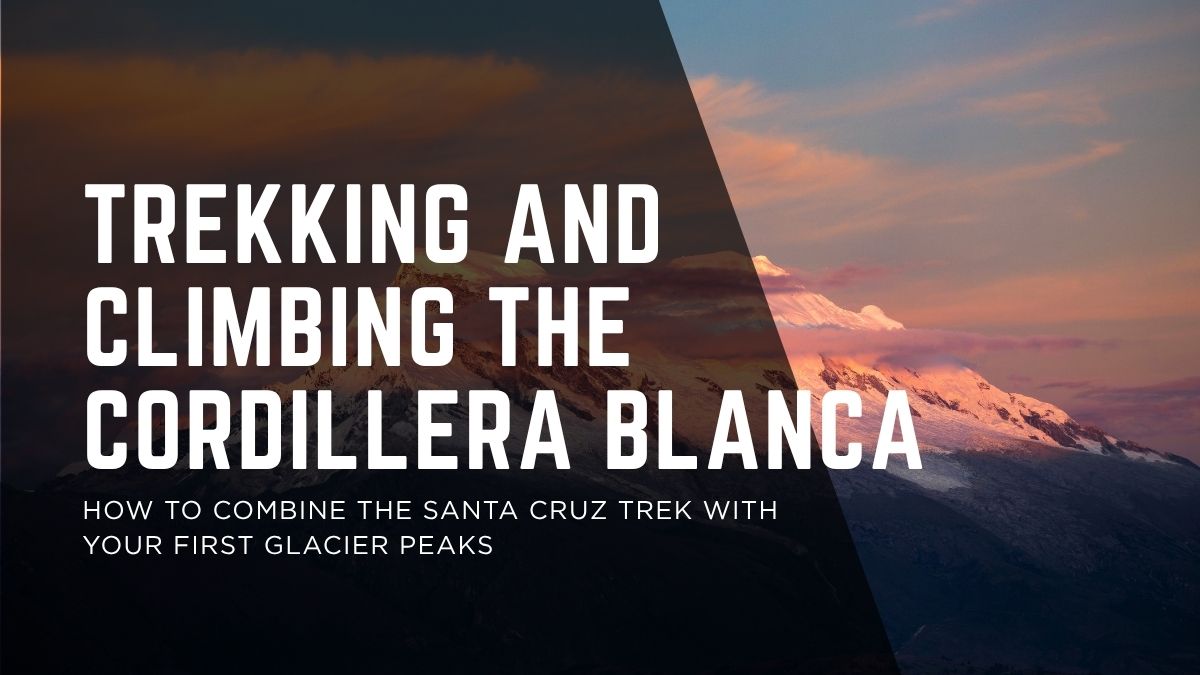
Huaraz sits at 3,050 m (10,000 ft) in the Callejón de Huaylas, and the Cordillera Blanca rises straight up from the valley on its east side. Huascarán National Park alone holds 27 peaks above 6,000 meters, with the Santa Cruz trek running through the middle of them. That layout is the whole reason to plan a trip here. In two weeks you can walk a four day trek, climb one or two glaciated summits, and let the trek do most of your acclimatization for the climbs.
UNESCO’s World Heritage listing for Huascarán National Park calls the range the world’s highest tropical mountain range. If you’re still choosing a country, our guide to high altitude mountaineering in South America compares all five. This article is the plan for the Cordillera Blanca once you’ve picked Peru.
Cordillera Blanca at a glance
- Base town: Huaraz, 3,050 m (10,000 ft), about 8 hours by bus from Lima
- Highest peak: Huascarán, 6,768 m (22,205 ft), the highest mountain in Peru
- Peaks above 6,000 m in Huascarán National Park: 27
- Season: roughly May to September, the dry season
- Classic trek: Santa Cruz, about 50 km over 4 days, high point Punta Unión at 4,750 m
- Classic first summits: Vallunaraju, Urus Este, Ishinca, Pisco
Why the Cordillera Blanca works for a first climbing trip
Several summits, one base camp
In many ranges each summit means a new approach. In the Ishinca valley, one base camp at about 4,350 m serves three summits of rising difficulty. Pack animals carry the gear in from the road, and the walk takes about half a day.
The road is close
From Huaraz, local transport reaches the main trailheads in a few hours, and several valleys have refugios and arrieros, the local mule drivers who move loads to base camp.
The season fits a northern vacation
The range sits about 9 degrees south of the equator. Its dry season runs roughly May through September, the same window as North American and European summer vacations, and it brings long runs of stable weather for glacier climbing.
The classic first summits
| Peak | Summit | Starting point | Why people pick it |
|---|---|---|---|
| Vallunaraju | 5,686 m (18,655 ft) | Close to Huaraz | Two days round trip, the shortest glacier climb from town |
| Urus Este | 5,420 m (17,782 ft) | Ishinca base camp | The usual first glacier day in the valley |
| Ishinca | 5,530 m (18,143 ft) | Ishinca base camp | A straightforward snow climb, often the second summit |
| Pisco | 5,752 m (18,871 ft) | Llanganuco valley, with a refugio at base camp | The summit view |
| Tocllaraju | 6,032 m (19,790 ft) | Ishinca valley, high camp above base camp | A first 6,000er, with steeper ground near the top |
Pisco is climbed mostly for what you can see from it. Alpamayo at 5,947 m (19,511 ft), Chacraraju, the Huandoy peaks and Artesonraju are all in view from the summit. Artesonraju is widely repeated as the model for the Paramount Pictures logo, though Paramount has never confirmed it.
The Ishinca valley is the range’s classroom. Urus Este and Ishinca are the first two rungs, and Tocllaraju sits directly above as a real mountaineering objective and, for many climbers, their first 6,000 meter summit. A week in that one valley can take an acclimatized climber through all three. Our Peru trekking and climbing guide has typical guided prices for that program.
None of these normal routes needs technical climbing skill. All of them need solid fitness, proper acclimatization and a rope, because they are glaciated mountains with crevasses. The glaciers are also retreating fast enough to change routes from one season to the next. Peru’s park authorities closed the Cordillera Blanca’s snow peaks to climbing from December 24, 2025 to March 31, 2026, citing glacier retreat and new crevasses and lakes, so check the current status of your peak before you pay a deposit. Huaraz has a large resident community of certified mountain guides, and for a first glacier climb you want one of them.
The trek that anchors the trip
Even if you never rope up, the Santa Cruz trek justifies the flight. It covers about 50 km in four days and crosses Punta Unión at 4,750 m, a notch in the ridge with Taulliraju directly above and turquoise lakes below. A side trip from the Santa Cruz valley side of the pass leads to the Alpamayo viewpoint at Laguna Arhuaycocha.
Day hikes fill the gaps. Laguna 69 sits at about 4,600 m under Chacraraju and is the range’s best known day hike. It’s also a stiff acclimatization day, with roughly 700 meters of climbing from the trailhead. Laguna Churup, closer to Huaraz, is the usual warm up before it.
The trek and the climbs aren’t competing plans. Done in the right order, they’re one plan.
A two week Cordillera Blanca blueprint
| Days | Plan | Sleeping altitude |
|---|---|---|
| 1 to 3 | Huaraz, easy walking, day hikes to Laguna Churup and Laguna 69 | 3,050 m |
| 4 to 7 | Santa Cruz trek | Roughly 3,700 to 4,250 m, crossing 4,750 m |
| 8 to 14 | Ishinca valley or Pisco from Llanganuco, for two or three summits | Base camps at about 4,350 to 4,600 m, higher on summit nights |
The trek is the acclimatization. By day eight you’ve spent a week at 3,050 m or higher, including four nights on the trek, and crossed 4,750 m on foot, which is the slow, repeated exposure your body needs before a midnight start at 5,000 meters and above. Fly in and head straight for a summit and you get the opposite, and Huaraz’s altitude is high enough on its own to flatten some people for the first two days.
Build the fitness before you leave home, because this plan uses all of it. You need the durability to string hard days together, an aerobic base built at whatever elevation you live at, and descent strength, since every one of these summits is a midnight start with a long descent after it. Altitude runs through the whole trip, so learn the signs of altitude illness from a proper medical source before you go. Awareness only, not medical advice.
Two plans cover the two halves of this trip. The Trekking Fitness Plan is 8 weeks of strength and aerobic conditioning, with rucks that build to 3 to 4 hours and stair climber sessions, which is the base for Santa Cruz. The 10 Week Mountaineering Fitness Plan is built for non technical glaciated peaks like Pisco and the Ishinca summits, with loaded rucks up to 3 to 4 hours, a 30 minute sustained stair climber climb, and descent work in every week.
