
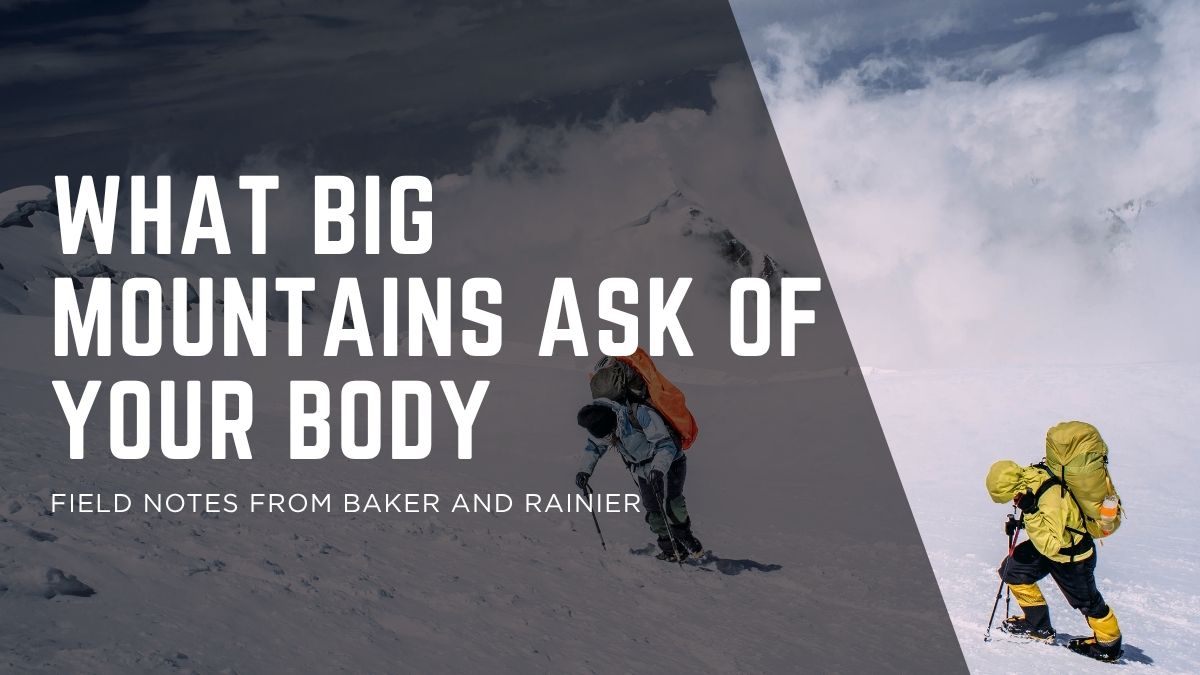
In July, seven of us spent ten days on a mountaineering course in the Cascades. Mount Baker first, then Mount Rainier, and we summited both. Before the carry to high camp we put every pack on a scale. The lightest was 48 pounds. The heaviest was 57.
That scale reading frames every other note we brought home from Baker and Rainier. The notebook has seven physical demands in it, and very few of them are specific to these two volcanoes. The same list turns up on Mont Blanc, on Orizaba and the big volcanoes of Ecuador, and on almost any first roped summit. The route changes how hard each one hits.
The trip in numbers
- Mount Baker: 3,286 m (10,781 ft)
- Mount Rainier: 4,392 m (14,410 ft)
- 10 days, 2 summits, 7 climbers
- Pack weights before the carry to high camp: 48 to 57 lb (22 to 26 kg)
- Rainier summit day alarm: 1 am
What we logged on Baker and Rainier
Everything happens under the pack
Every demand below happened with 48 to 57 pounds on our backs. Walking, climbing, descending, balancing on rock, even bending down to tie a boot.
Your number depends on the trip you booked. A full carry like Baker or Rainier puts the whole camp on your back. Hut routes such as the normal route on Mont Blanc run much lighter. On Aconcagua, mules take the heavy bags to base camp and your own carries start above it. Work out which kind of trip yours is and train with that pack. Legs that have only ever trained unloaded meet a different job the first time 50 pounds goes on, and we laid out how to build up to it in our guide to training with a heavy pack.
The climb, which you already expected
Hours of vertical gain, day after day. Rainier alone involves more than 9,000 feet of gain over roughly ten miles on its standard routes, according to the National Park Service. Training plans are usually built around this demand, and it was every bit as hard as advertised.
It was also the least surprising thing on the list. You knew the mountain went up.
Rock underfoot
Long sections of the approach are not trail. They are boulder fields and rocky slopes where each step is a choice: hopping rock to rock with the pack on, uphill and down, and picking a line across a river from one stone to the next. Scree and talus on the big volcanoes set the same test, and so does any approach where the path runs out.
Leg strength helps here, but it isn’t the main requirement. Balance, foot placement, and the confidence to commit your full weight to a rock you chose two moves earlier matter more.
Hours of braking on the way down
Coming down is hours of braking. On every step your legs catch your bodyweight plus the pack, and it happens after the climb has already drained you, which is why descents are where tired legs give out.
The quads do this work eccentrically, lengthening under load. That type of work is what leaves muscles sore for days afterward when it hasn’t been trained, and on a mountain it arrives in the biggest dose of the trip. The mechanics and the fix are in our descent training guide.
Camp is a mobility test
Getting into a low tent. Sitting up in it. Cooking hunched over. And the deep squat over a hole in the ground, several times a day, in boots, on a slope.
Huts soften this test without removing it. If your hips and ankles can’t get you into those positions comfortably, every day on the mountain costs more energy than it should.
The 1 am alarm
On Rainier the alarm went off at 1 am. Starts in that window are normal on glaciated peaks, because snow is firmer and snow bridges are more stable in the overnight cold than after the sun hits them. On Cotopaxi, teams usually leave the refuge around midnight. On Orizaba they leave in the small hours to be off the glacier before it softens.
The sequence barely changes from peak to peak. A few hours of poor sleep at altitude (here’s why sleep falls apart up high), a body convinced it is the middle of the night, then the biggest physical day of the trip. None of us felt good at that hour. What decided the day was how much fitness sat underneath the bad feeling.
Fog, the mental kind
Deep in a long day, thinking slows and the hours blur. What we noticed across both climbs: the fitter you are, the later that fog arrives. You stay clear longer, you make better small decisions, and you remember more of the route. After paying for a trip like this, you want to remember the summit.
Training for the whole list
The belief we came home holding more firmly than when we left: fitness does more than get you to the top. It decided how pleasant those ten days were, from the first carry to the last river crossing, and it improves your odds on summit day.
So train for all seven. The load, the vertical, the rough ground, the braking, the camp positions, the dark start and the clear head. A plan built only on vertical covers one of them.
The 10-Week Mountaineering Fitness Plan is built around that list. Carrying targets are set as a share of your bodyweight, and the ruck builds to 3 to 4 hours by week 9. Slow lowering, single leg and lower leg work run through every week for the descent. The cool-downs include a deep squat hold for camp positions, the loaded stair climber sessions grow into a 30 minute sustained climb, and the plan covers how to move through boulder fields and river crossings. If a glaciated peak like Baker or Rainier is on your list, that’s where we’d start.
